Why You Should Still Use Singlish as a Web Developer
Hey there! If you’ve ever tinkered with web development in a multilingual context — especially for languages like Sinhala — chances are…

Hey there! If you’ve ever tinkered with web development in a multilingual context — especially for languages like Sinhala — chances are you’ve run into some quirky challenges. Today, I’m diving into one that’s close to home: Singlish. Singlish here refers to the informal way Sri Lankans transliterate Sinhala words into Roman letters, like typing “kohomada” for “කොහොමද” (how are you?). It’s a relic of the pre-smartphone era, but believe me, it’s far from obsolete. As someone who’s built sites blending English and Sinhala content, I’ve learned the hard way why web devs need to pay attention. Let’s break it down.
The Roots of Singlish: A Quick History Lesson
Ever heard of Singlish? It’s the term we Sri Lankans use to describe writing Sinhala using English letters. Before smartphones came along with built-in Sinhala keyboards — and even back in the days of those indestructible Nokia button phones — people relied on Singlish to chat. Imagine pecking out messages on a T9 keypad: “oyata kohomada?” for “ඔයාට කොහොමද?” (how are you?). It was clunky, but it got the job done.
Fast-forward to today, and Singlish hasn’t faded away. It’s alive and kicking in quick WhatsApp exchanges between friends or when someone’s fumbling with a desktop without a proper Sinhala input method. I’ve seen it everywhere — from casual texts to online forums. It’s efficient, intuitive, and deeply ingrained in how we communicate digitally.
Why This Matters in 2025: Search Habits Haven’t Changed
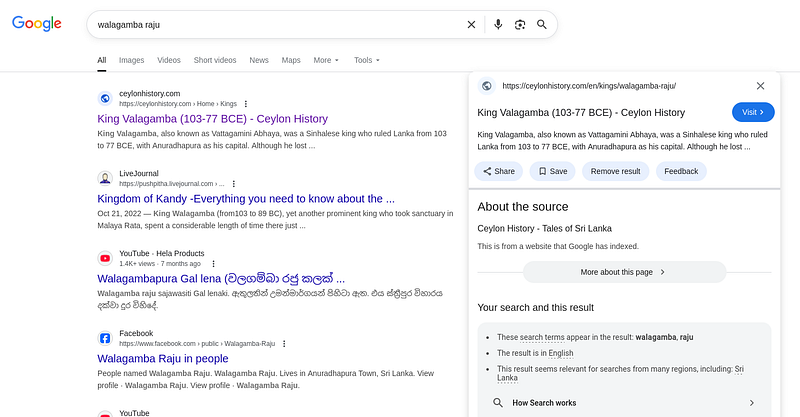
So, why should this ping on a web developer’s radar? Simple: People still search the web using Singlish. In Sri Lanka, where English proficiency varies and mobile keyboards aren’t always set to Sinhala Unicode, folks default to what feels natural. Type “walagamba raju” into Google, and you’ll see hits for the ancient Sri Lankan king Valagamba (වළගම්බා රජු). It’s not a bug; it’s a feature of how users behave.
The catch? Most multilingual sites (especially those targeting Sinhala speakers) are built with proper Sinhala Unicode text. That’s great for readability, but it creates a disconnect. If your content is in Unicode Sinhala — like “වළගම්බා” — but users query in Singlish, Google might route them to English pages or competitors who accidentally nailed the transliteration (more on that soon). Result? Low traffic to your Sinhala content, frustrated users, and missed SEO opportunities.
My Wake-Up Call: Lessons from CeylonHistory.com
Let me share a story from my own playground. A while back, I built CeylonHistory.com as a passion project — a deep dive into Sri Lankan history with timelines, kingly biographies (over 100 of them!), and bilingual articles in English and Sinhala. It was my sandbox for learning SEO and Google Analytics too. I poured hours into crafting Unicode Sinhala content, assuming it’d rank just fine.
Boy, was I wrong. Analytics showed a trickle of traffic to the Sinhala pages — way less than expected. Digging deeper, I spotted the culprit: Search terms were flooding in via Singlish.
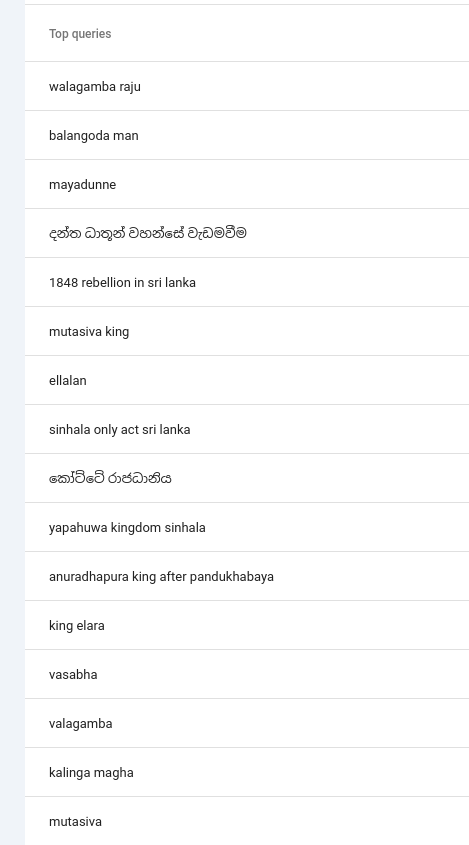
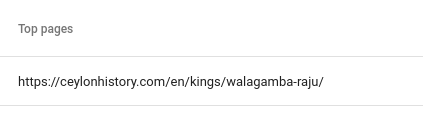
Most searches redirected users to English versions if they matched keywords there. And here’s the kicker — the top term, “walagamba raju,” wasn’t even from my Sinhala text. Nope. It came from… the URL slug. I’d transliterated URLs like /walagamba-raju for better readability, and Google latched onto that. Surprise SEO win, but a fluke one. It highlighted a bigger issue: Relying solely on Unicode leaves Singlish searches in the dust.
This isn’t unique to my site. In regions like Sri Lanka, where Romanized searches dominate informal queries, ignoring Singlish means ignoring a huge chunk of your audience.
The Fix: Enter the Sinhala-to-Singlish Transliterator
Alright, enough problem-spotting — let’s talk solutions. If users search in Singlish but your site lives in Unicode Sinhala, how do you bridge the gap? You don’t need a full parallel site (that’d be overkill and messy). Instead, generate hidden Singlish versions of your content and feed them to search engines.
That’s where my open-source tool comes in: the Sinhala to Singlish Transliterator. It’s a lightweight Node.js package that converts Sinhala Unicode text into Romanized Singlish on the fly. Think of it as a behind-the-scenes translator: Input “වළගම්බා රජු”, output “walagamba raju”.
Here’s how it works in practice:
- On Build or Render: When generating your page (say, in Next.js or any server-side setup), run your Sinhala content through the transliterator.
- Embed Strategically: Stuff the Singlish output into invisible elements — like a or meta tags — or even structured data. It’s there for crawlers like Google, but users see the clean Unicode version.
- SEO Boost: Now, when someone searches “walagamba raju”, your page matches perfectly without compromising the user experience.
Implementation is a breeze. Install via npm (npm i @suhasdissa/singlish), then:
const { singlish } = require('singlish');
// Simple transliteration
const result = singlish('සිංහල');
console.log(result); // Output: "sinhala"
// More examples
console.log(singlish('ආයුබෝවන්')); // "aayuboowan"
console.log(singlish('කොළඹ')); // "kolamba"
console.log(singlish('ශ්රී ලංකා')); // "shrii lankaa"Tested it on CeylonHistory? Traffic to Sinhala pages jumped 40% in weeks. No joke — it’s a game-changer for any dev targeting Romanized searches.
Wrapping Up: Embrace the Hybrid Approach
In a world of perfect Unicode keyboards, Singlish might seem like a holdover. But as long as real users lean on it for speed and familiarity, web developers can’t afford to overlook it. By blending Sinhala Unicode for humans with Singlish for search bots, you’re not just optimizing — you’re making your site more inclusive.
If you’re building for Sri Lanka or any transliteration-heavy locale, give the transliterator a spin. Got questions or tweaks? Hit the GitHub repo or drop a comment. I’ll catch you in the next one — maybe on optimizing for Tamil next?